
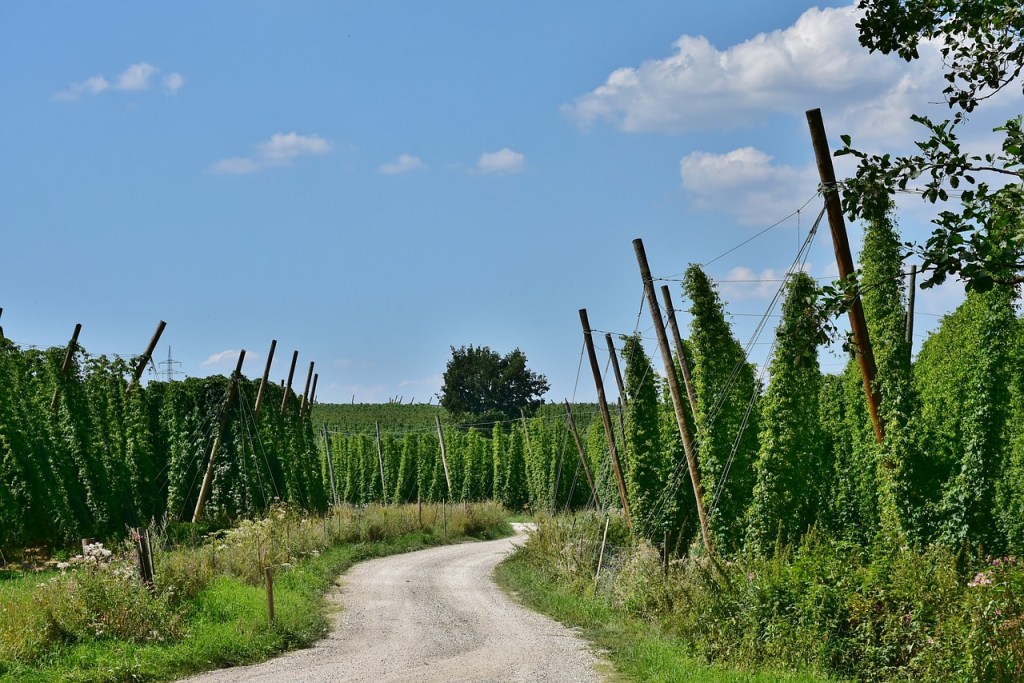
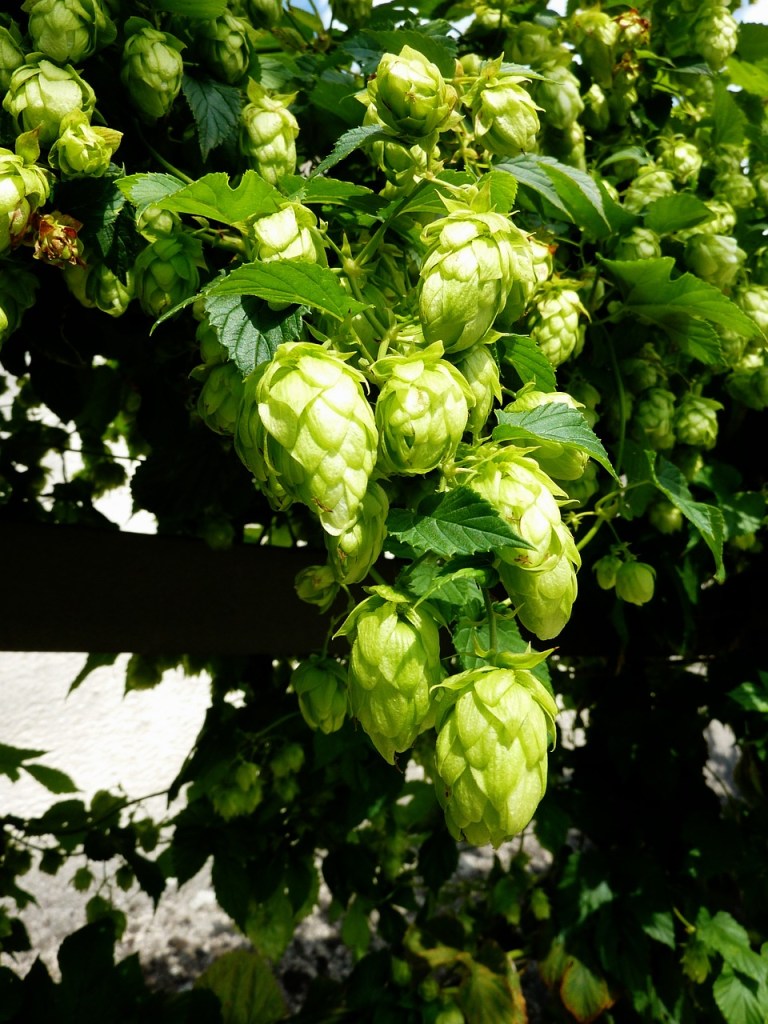
What are hops? Hops are the flowers of a climbing perennial plant that are a major component in brewing beer. Shaped like a cone they grow on vines up to twenty-five feet high. They are grown around the world in moderate climates with plenty of sunshine and some of the most important producers include Germany, New Zealand, the Czech Republic, and the USA.
The key ingredient is a resin that contains volatile acids that add characteristic aromas and bitterness to beer as well as key anti-microbial qualities that for a long time in brewing provided an essential preservative role. When brewers need to add bitter flavours to their brew the hops are add when the wort is being boiled. If the beer needs lots of hoppy aromas more hops can be added as the liquid is cooled or even after fermentation. This is called dry hopping. Some hops add more bitterness, some are more scented, and some combine both functions. The aroma profile of hops includes citrus fruits including grapefruit, lychees, peach, melon, and passionfruit, fresh herbs, newly cut grass and earhty notes.
Prior to using hops brewers added bitter herbs like bog myrtle and yarrow. Today brewers still use herbs and other aromatics like orange peel and juniper to add more flavour dimensions to their brews. One of the first records of using hops was in 882 A.D. The abbot of the Corbie Benedictine monastery in Picardy in France recorded his orders rules for the running an abbey. This included the collection of wild hops for making beer.
In 1516 the Duchy of Bavaria enacted the famous Reinheitsgebot or purity law which restricted the ingredients of beer to purely water, barley, and hops. At this time yeasts role was not understood in the brewing process. The law also set the price that could be charged to prevent profiteering by unscrupulous innkeepers. Although the law has been amended to include other ingredients such as fining it remains a strong marketing tool for German breweries and has been adapted by other beer producers around the world.

By the eighteen hundreds brewers in England were producing heavily hopped beers that where sent to India. It was discovered that the long sea journey improved the finished beer and it was hugely popular. India Pale Ales or IPA were soon exported across the globe to New Zealand and Australia. The India was often dropped and the beer was simple known as Export Pale. In the UK the popularity of IPA declined alongside or real ales after the second world war but remerged in the nineteen nineties. Now both UK and American style hoppy IPAs are hugely popular.
Some popular hop varieties
Citra
Is the most popular hop grown in America, by far the world’s biggest producer. It adds both bitterness and aroma to beer and is the powerhouse behind many IPA’s.
Cascade
Cascade can be used for both bitterness and its distinctivegrapefruit citrus aromas. It was the principle hop in the first wave of modern American Pale Ales and IPA’s.
Saaz
From the Czech Republic Saaz has a brewing pedigree of over seven hundred years. It adds floral and herbaceous notes and is normally added in late boils or in dry hopping.
Fuggle
Was first grown in the UK and adds herbaceousnotes of freshly mown grass and mint and is normally added in late boils or in dry hopping.
Hallertau Mittelfrüh
Is grown in Bavaria in Germany. It is known for its spicy and citrus aromas and is normally added in late boils or in dry hopping.
East Kent Goldings
A bittering hop East Kent Goldings has delicate earthy aromas of thyme and spices.
Styrian Golding
A clone of Fuggle some brewers believe it to be superior, Styrian Golding is an aroma hop added in late boils and dry hopping. It has spicy and sweet resin aromas.
Galaxy
Australia’s number one hop, Galaxy is used for both bittering and aroma. It has one of the highest concentrations of essential oils of all hops and pronounced citrus and tropical fruit aromas of passion fruit, pineapple, and peach.


 THE CASKAWAY
Leave a reply to Stinky Bay Session IPA – The Caskaway Cancel reply